

Why Do Summer Storms and Flash Flooding Cause Sudden Drain Backups at Home?
A heavy summer storm rolls through, the rain lets up within the hour, and somehow water is now backing up through a floor drain or the lowest toilet in the house, sometimes with a sewage smell that was not there before the storm. This is not a coincidence, and it is rarely caused by anything a homeowner did wrong. Sudden drain backups during and after North Texas storms typically happen because stormwater is overwhelming the sanitary sewer system through cracked pipes, improper connections, or a municipal system that simply cannot move that much water fast enough, and the symptoms show up at the lowest drain in the house first.
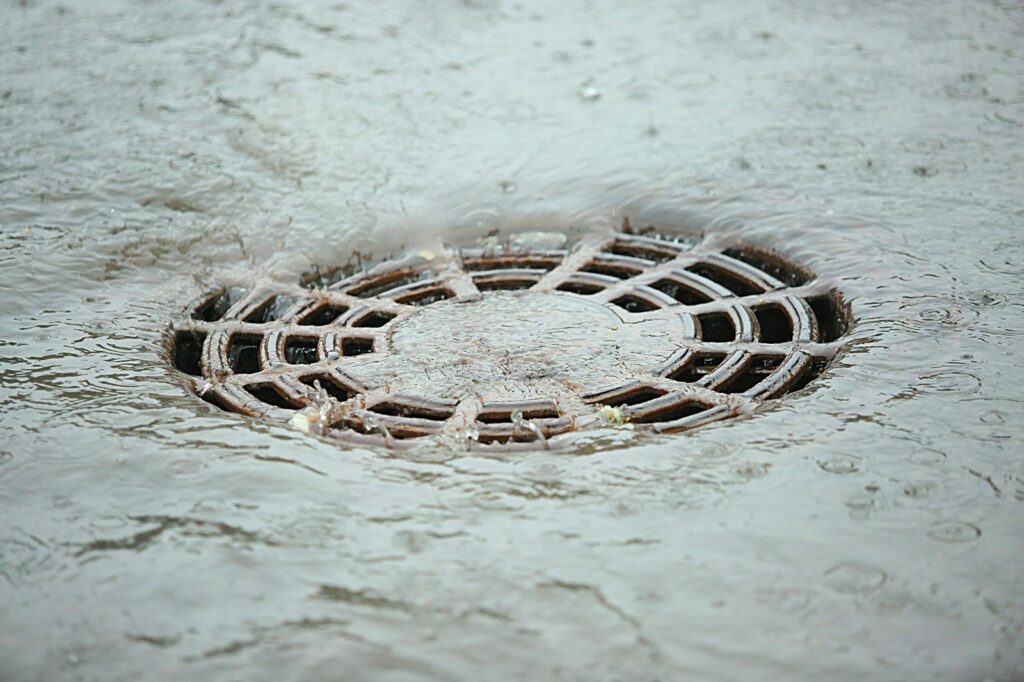
This guide explains what is actually happening inside the sewer system during a flash flood event, why homes across the DFW Metro area and Johnson County are particularly exposed to this problem, and what separates a backup that clears on its own from one that needs a same-day call to a licensed plumber.
What Is a Storm-Related Drain Backup?
A storm-related drain backup happens when wastewater is forced backward through a home’s plumbing instead of flowing forward to the municipal sewer main, usually because the sewer main itself is running at or above capacity during heavy rain. Unlike an isolated clog in a single drain line, a storm-related backup typically shows up first at the lowest drain in the house, a basement floor drain, a garage floor drain, a downstairs shower, or a ground-floor toilet, because that is the point where water finds the easiest path once the system downstream is full. The timing is the biggest clue: a backup that starts during or shortly after a heavy rain event, and improves once the storm passes and the municipal system catches up, points toward a storm-related cause rather than a routine clog.
What Causes Drain and Sewer Backups During North Texas Storms?
Several conditions specific to this region make storm-related backups more common here than in many other parts of the country.
Expansive clay soil and drought-to-deluge cycles. North Texas sits on expansive clay soil that swells when saturated and shrinks and cracks during dry spells, and the region’s weather pattern of extended dry stretches followed by sudden, heavy rain puts buried sewer pipe through repeated stress cycles. Each time the ground shifts, once watertight pipe joints can separate slightly, creating small gaps where soil and groundwater work their way in over time.
Aging clay sewer laterals. Many homes across Fort Worth, Arlington, Burleson, and the surrounding communities were built with clay sewer laterals, the pipe section connecting the house to the municipal main, decades ago. Clay pipe has a design life that many of these lines have now exceeded, and aging joints are far more prone to root intrusion, cracking, and separation than modern PVC. A storm does not create this weakness, but it is very good at finding it.
Inflow and infiltration. The Environmental Protection Agency identifies inflow and infiltration as a leading cause of sanitary sewer overflows nationwide, and the same mechanism drives many residential backups. Inflow happens when stormwater enters the sanitary sewer system directly, through a cracked manhole, a cross-connected storm drain, or a downspout or sump pump improperly tied into the sanitary line. Infiltration happens more slowly, as groundwater seeps in through cracked pipes and failed joints. Both add volume to a system that was sized for sewage, not stormwater, and during a flash flood event that extra volume has to go somewhere.
Storm drains and catch basins at capacity. North Texas storms do not need to be long to cause problems, they need to be intense. On March 4, 2026, Dallas Fort Worth International Airport recorded 1.55 inches of rain in a single day, breaking a daily rainfall record that had stood since 1937, according to National Weather Service data. When rainfall arrives that quickly, storm drains and catch basins can reach capacity well before the worst of the storm has even passed, and any sanitary sewer connections nearby feel the pressure too.
Warning Signs That Point to a Storm-Related Backup
Watch for these signs during or shortly after heavy rain:
- Water or sewage backing up through a floor drain, downstairs shower, or the lowest toilet in the house, often before any other fixture shows a problem
- Multiple drains or fixtures backing up at the same time, rather than just one slow drain, which points toward the main line rather than an isolated clog
- Gurgling sounds from a toilet or floor drain when a sink, washing machine, or shower somewhere else in the house is running
- A backup that starts during or shortly after heavy rain and noticeably improves once the storm passes
- A sewage odor accompanies the backup, rather than just standing water
- A sump pump pit that fills constantly during rain or a sump pump that runs nonstop without the water level dropping
Any one of these signs on its own is worth a closer look. Several of them together during or right after a storm are a strong signal that the cause is upstream of your fixtures, in the main line or the municipal system, rather than a simple clog you can clear yourself.
DIY vs. Professional Repair
A single slow drain or an isolated clog in one fixture is often something a homeowner can handle with a plunger or a drain snake. A storm-related backup is a different situation, because the blockage or overload is typically in the main line rather than in one branch of the plumbing, and clearing a single fixture will not solve a problem that originates downstream.
A licensed plumber should be the first call when:
- More than one drain or fixture backs up at the same time, especially the lowest drain in the house
- A sewage odor accompanies the backup rather than just standing water
- The backup recurs with every significant rain event instead of being a one-time issue
- There is standing water in a crawlspace, basement, or near the foundation after a storm
- You cannot locate the home’s main sewer cleanout or are unsure how to access it safely
Attempting to clear a main line backup with over-the-counter chemical drain cleaners is not effective for this kind of problem and can be unsafe given the volume of wastewater involved. A camera inspection is usually the fastest way to confirm whether the issue is in the private lateral, at the connection to the municipal main, or further downstream.
Solutions for Storm-Related Drain Backups
Drain cleaning and camera inspection. Professional drain cleaning paired with a camera inspection identifies exactly where a line is blocked, cracked, or compromised by root intrusion, which avoids guesswork and unnecessary digging.
Hydro-jetting. For lines with significant grease, scale, or root buildup, hydro-jetting clears the full diameter of the pipe using high-pressure water rather than just punching a hole through the blockage. We cover this in more detail in our guide to recurring drain clogs and hydro-jetting, which applies just as much to storm-stressed lines as it does to routine buildup.
Sewer line repair or lining. When a camera inspection finds a cracked, offset, or root-damaged section of pipe, trenchless lining or targeted sewer line repair can restore the line without excavating an entire yard.
Backwater valves. A backwater valve is a one-way device installed on the main sewer line that allows wastewater to flow out toward the municipal system but closes automatically if the city main surcharges and tries to push flow back toward the house. For homes that have experienced even one storm-related backup, this is one of the most effective ways to prevent a repeat.
Sump pump and battery backup. In homes with a sump pump managing groundwater or a crawlspace, pairing the primary pump with a battery backup keeps the system working during the kind of power outage that often accompanies a severe storm, which is exactly when a sump pump is needed most.
How North Texas Storms Change the Risk
North Texas does not see constant rain, averaging somewhere in the mid-30-inch range annually, but the region’s storms tend to arrive in short, intense bursts rather than spread evenly across the year. That pattern matters more to a sewer system than total rainfall does, because pipes and storm drains are sized around expected flow rates, not just yearly totals.
The Tarrant Regional Water District, a local sponsor of the Central City Flood Control Project, plays a direct role in managing this risk for Fort Worth and much of the surrounding area, working alongside the U.S. Army Corps of Engineers on the levee system that protects the city from Trinity River flooding. That is a separate system from a home’s private sewer lateral, but both are stressed by the same storm events.
On the municipal side, the EPA notes that reducing inflow and infiltration through system rehabilitation and repairing broken or leaking service lines is one of the primary ways communities address storm-driven sewer overflows. On the homeowner side, the equivalent step is making sure your own private lateral, the section of pipe between the house and the municipal connection, is not contributing cracked joints or root intrusion to the same problem.
FAQs About Storm-Related Drain Backups
What is the difference between a storm-related backup and a regular clogged drain?
A regular clog is usually isolated to one fixture or one branch line and is caused by something inside that specific pipe, such as hair, grease, or a foreign object. A storm-related backup typically affects multiple drains at once, originates from pressure or volume in the main sewer line rather than a single blockage, and is closely tied in timing to heavy rainfall. The fix for each is different, which is why correctly identifying which one you are dealing with matters before reaching for a plunger.
Why does my basement or garage floor drain back up before any other fixture in the house?
Floor drains are almost always the lowest point in a home’s plumbing system, which means they are the first place water finds an escape route when the sewer line downstream is full or under pressure. Water naturally takes the path of least resistance, and a floor drain sitting below the level of other fixtures becomes that path during a backup, even if every other drain in the house seems to be working normally.
Is a sewer backup during a storm covered by homeowners insurance?
Standard homeowners insurance policies typically exclude sewer backup damage unless the policyholder has purchased a specific sewer backup or water backup endorsement. Coverage details vary significantly by insurer and policy, so this is a question best directed to your insurance provider directly rather than assumed one way or another.
Can heavy rain cause a sewage backup even if my home’s plumbing is in good condition?
Yes. A storm-related backup is frequently caused by the municipal sewer main reaching capacity rather than anything wrong with the home’s own plumbing. If the city system surcharges during intense rainfall, water can be pushed backward into any home connected to that line, regardless of how well-maintained the home’s interior plumbing is. This is exactly why a backwater valve is worth considering even for homes with no plumbing problems of their own.
What is a backwater valve and do I need one?
A backwater valve is a one-way valve installed on the main sewer line that allows wastewater to flow out of the home normally but closes automatically if pressure from the municipal side tries to push flow back in. Homes that have experienced a storm-related backup, or that sit in a low-lying area relative to the municipal sewer connection, are good candidates for this kind of protection.
Why do multiple drains back up at the same time during a storm?
When the blockage or pressure is in the main line rather than a single branch, every fixture connected to that main line is affected simultaneously. This is one of the clearest signs that a backup is storm-related rather than a routine clog, since an isolated clog in a branch line would only affect the fixtures on that specific branch.
Is it safe to use my plumbing during an active storm-related backup?
It is best to minimize water use, especially running multiple fixtures like a washing machine, dishwasher, or shower, until the backup clears or a plumber has assessed the situation. Adding more water to a system that is already struggling to drain can make a backup worse and increase the risk of overflow at the lowest point in the house.
How can I tell if the backup is coming from the city’s sewer main versus my own line?
A camera inspection is the most reliable way to determine this with certainty, since a plumber can visually trace the line from the home’s cleanout toward the municipal connection. As a general indicator, backups that affect every drain in the house simultaneously and correlate closely with heavy rainfall often point toward the main line or municipal system, while a backup limited to fixtures on one branch is more likely isolated to the home’s own plumbing.
Does my homeowner’s insurance need a specific sewer backup rider?
In most cases, yes. Standard policies commonly treat sewer and drain backup as an exclusion rather than a covered peril unless a specific endorsement has been added. Reviewing your policy directly with your insurance provider is the only reliable way to confirm what your specific coverage includes.
Can tree roots make storm-related backups worse?
Yes. Tree roots are drawn to the moisture and nutrients inside sewer lines and can work their way into pipe joints that have already loosened due to soil movement. A line with root intrusion has a reduced effective diameter even before a storm hits, which means it reaches capacity and backs up sooner during heavy rain than a clear line would.
Why does an older home seem more prone to storm backups than a newer one?
Older homes are more likely to have clay sewer laterals that have exceeded their design life, along with joints that have had decades to loosen due to repeated soil expansion and contraction. Newer homes typically have PVC laterals with fewer joints and more flexibility, which makes them somewhat more resistant to this specific failure mode, though no system is entirely immune to a severe enough storm.
What should I do immediately if sewage is backing up into my home during a storm?
Stop using water in the home as much as possible, keep people and pets away from the affected area since backed-up sewage is a contamination risk, and contact a licensed plumber for emergency service. Avoid attempting to manually clear a main line backup yourself, since the volume and contents involved are different from a simple fixture clog.
Can a sump pump prevent sewer backups, or is that a different system entirely?
A sump pump manages groundwater and surface water that collects in a basement, crawlspace, or sump pit, while a sewer backup involves wastewater being forced backward through the sanitary sewer line. They are different systems addressing different problems, although a sump pump that is improperly connected to the sanitary sewer line instead of a stormwater discharge point can actually contribute to inflow problems rather than solve them.
How often should my home’s main sewer line be inspected if I live in a flood-prone area?
A camera inspection every two to three years is a reasonable baseline for older homes or homes in areas with a history of storm-related backups, with an additional inspection anytime a backup occurs or a property changes ownership. Homes with known clay laterals or mature trees near the sewer line benefit from more frequent checks.
Will a one-time hydro-jetting service fix a recurring storm-related backup for good?
Hydro-jetting clears grease, scale, and root intrusion from inside a pipe and can meaningfully improve flow capacity, but it does not repair a cracked, offset, or structurally damaged section of pipe. If a camera inspection identifies structural damage in addition to buildup, jetting paired with targeted repair or lining is typically what actually resolves a recurring problem rather than jetting alone.
When to Call Finntastic Plumbing
If a storm leaves you with a backed-up floor drain, a recurring sewage smell, or standing water that will not go away, it is worth getting a professional opinion before the next heavy rain makes the problem worse. Finntastic Plumbing provides drain cleaning in Fort Worth and across the DFW Metro and Johnson County area, backed by camera inspection equipment and hydro-jetting capability for lines that need more than a basic snake. Our team is fully licensed, bonded, and insured, and our emergency plumbing service is available 24/7 for the kind of backup that will not wait for business hours. We are rated A+ with the Better Business Bureau and maintain a 4.8 average rating across our verified customer reviews. Call 817-899-7315 or contact us online to schedule a camera inspection before the next storm finds the same weak point again.